

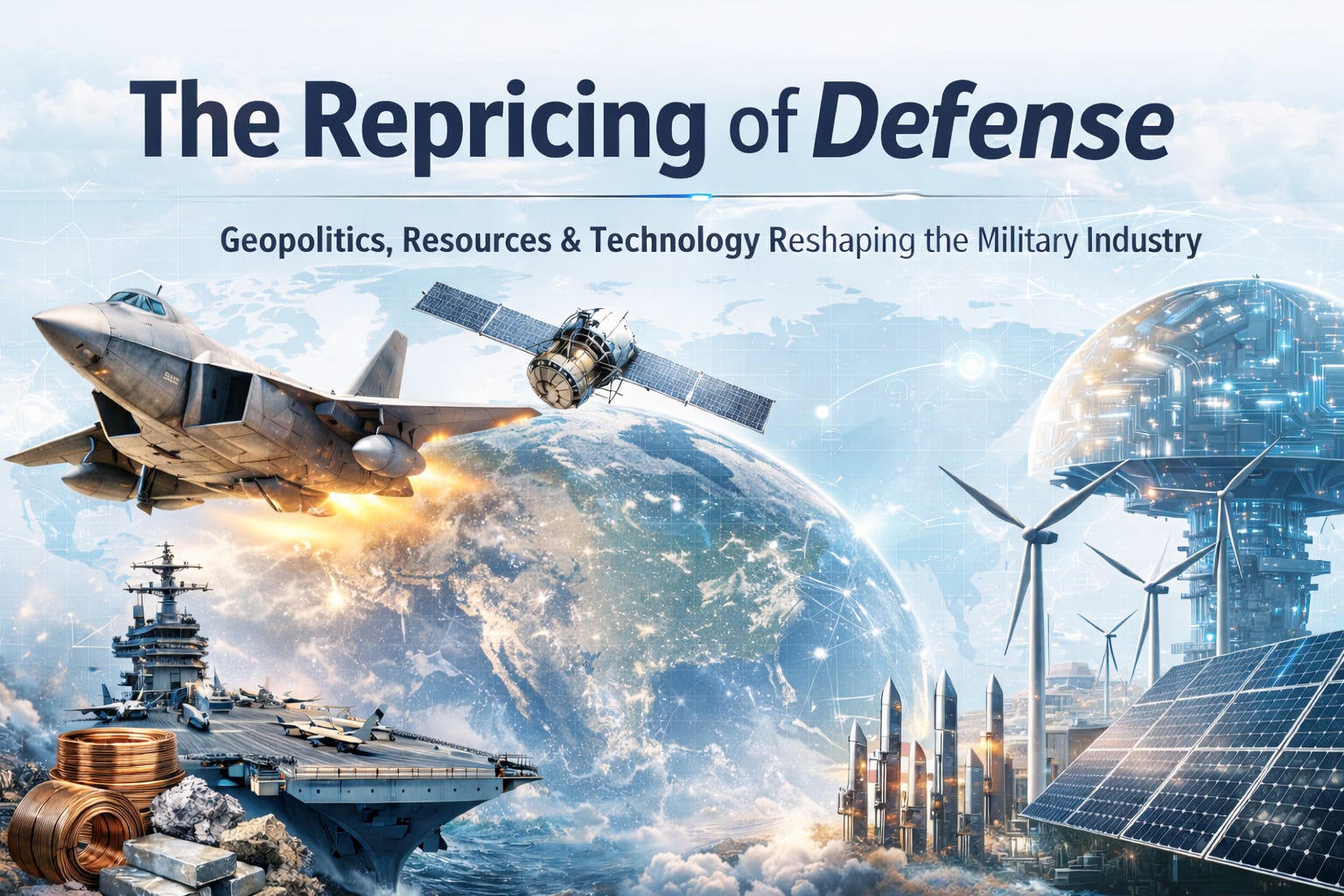
The Repricing of Defense|军工的重定价
How Geopolitics, Resources, and Technology Are Reshaping the Global Military Industry|地缘政治、资源与技术如何重塑全球军工产业

Independent research on structural shifts in energy, technology, and capital.
聚焦能源、技术与资本结构性变化的独立研究。
For informational purposes only. Not investment advice.
仅供信息参考,不应被视为投资建议。
Introduction|引言
For decades after the Cold War, the defense industry was widely perceived as politically constrained and fundamentally cyclical. Spending expanded during wars, contracted during peace, and remained subject to electoral and fiscal pressures. Defense exposure was therefore treated by many investors as tactical rather than structural.
冷战结束后的很长一段时间里,军工行业普遍被视为一个受政治制约、强周期性的行业。战争时期军费扩张,和平时期预算收缩,国防支出始终服从于选举与财政纪律。因此,对许多投资者而言,军工更多是战术性配置,而非长期结构性资产。
That perception is increasingly outdated. What we are seeing is not only a response to isolated conflicts, but a broader repricing of national security as a long-duration policy commitment—one that increasingly integrates resources, data, space, energy, and industrial capacity.
但这一认知正在快速失效。当前发生的并不只是对单一冲突的短期反应,而是国家安全作为“长期政策承诺”的系统性重定价,并且日益整合资源、数据、太空、能源与工业能力。
I. From Cyclical Spending to Structural Commitment
I. 从周期性军费到结构性承诺
Official data supports the view that global defense spending has moved into a higher regime. SIPRI reports that world military expenditure reached USD 2.718 trillion in 2024, rising for the tenth consecutive year (and accelerating year-on-year).
官方数据支持“军费进入更高平台期”的判断。根据 SIPRI 统计,2024 年全球军费开支达到 2.718 万亿美元,并已实现连续十年增长,且同比增速进一步抬升。
More important than the level is the framing: defense budgets are increasingly treated as multi-year industrial plans rather than discretionary line items. NATO’s defense-spending benchmark (2% of GDP) has historically been described as a “guideline,” but official and policy discussions in recent years have repeatedly reinforced that the benchmark should function as a floor for capability planning, not a ceiling.
比“花了多少钱”更关键的是“怎么定义这笔钱”。国防预算越来越像跨年度的工业规划,而非可随意收缩的弹性开支。北约的 2%(GDP 占比)长期被称为“指导目标”,但近年来在官方口径与政策讨论中,这一标准被反复强化为能力建设的底线而非上限。
Once defense is embedded in long-term fiscal planning, procurement becomes more continuous, capacity planning extends across decades, and private-sector investment (suppliers, software contractors, component makers) becomes structurally easier to justify.
一旦国防被纳入长期财政框架,采购将更常态化,产能规划以“十年”为单位展开,供应链与软件承包商等私营部门的投入也更容易获得持续性支撑。
II. Defense Is No Longer Only About Weapons
II. 国防不再只是“武器采购”
Modern defense doctrines increasingly define security as a system-level capability rather than a collection of platforms. In practice, “effective combat power” is increasingly determined by integration—how information, decision cycles, logistics, and communication networks are synchronized under stress.
当代国防越来越被理解为“系统能力”,而不是单一装备的堆砌。现实中,“有效战力”更取决于系统整合——信息、决策节奏、后勤与通信网络在压力条件下能否被高效同步。
This is one reason software and data infrastructure have moved closer to the center of defense modernization. The U.S. Department of Defense’s Data, Analytics, and AI Adoption Strategy explicitly frames accelerated adoption as a way to help leaders “make better decisions faster,” from headquarters to battlefield operations.
这也是软件与数据基础设施走向国防核心的原因之一。美国国防部发布的 《数据、分析与人工智能采用战略》明确强调,加速相关技术采用将帮助各层级领导者“更快做出更好的决策”,覆盖从高层指挥到战场一线。
In this framework, weapons remain necessary—but increasingly insufficient on their own. The practical edge shifts toward resilient communications, robust command-and-control, and the ability to absorb disruption while maintaining tempo.
在这种框架下,武器依然必要,但越来越不“充分”。真正的优势更偏向韧性通信、强指挥控制,以及在被干扰、被破坏时仍能维持作战节奏的能力。
III. Strategic Resources as a Core Defense Constraint
III. 战略资源成为国防的硬约束
A defining feature of this new defense era is the elevation of strategic minerals into national security planning. In the United States, the Department of the Interior—through the U.S. Geological Survey (USGS)—published the final 2025 List of Critical Minerals in November 2025, outlining 60 minerals deemed vital to U.S. economic and national security interests and vulnerable to supply disruption. These materials share three investable characteristics: concentrated supply, limited substitution, and dual-use demand across defense, energy transition, and high-end manufacturing.
这一轮军工重估中,一个最容易被低估、却最关键的变量,是战略矿产被正式纳入国家安全规划。在美国,内政部通过美国地质调查局(USGS)在 2025 年 11 月发布《最终 2025 年关键矿产清单》,列出 60 种对美国经济与国家安全至关重要、且面临供应链中断风险的关键矿产。这些矿产具备三个共同特征:供给高度集中、替代性有限、且军民两用需求强(覆盖国防、能源转型与高端制造)。
This is why governments increasingly deploy tools that look “industrial-policy-like”: stockpiles, export controls, preferential procurement, and—in some cases—direct financing. The investment takeaway is not that “resources always win,” but that upstream control increasingly behaves like a constraint on downstream defense output and readiness.
这也是为什么各国越来越多地使用近似“产业政策”的工具:战略储备、出口管制、采购倾斜,甚至直接融资。关键不在于“资源一定赢”,而在于上游控制正在越来越像一种硬约束,会直接影响下游军工产出与战备水平。
In effect, upstream control and processing capacity are no longer peripheral—they become a hidden but indispensable layer of defense capability. When security is defined by resilience, “resource security” is not a commodity cycle; it is an input to national power.
从本质上看,上游资源控制与加工能力已不再是边缘变量,而是现代国防能力中隐蔽但不可或缺的一层。当安全被定义为“韧性”,资源安全就不再是单纯的商品周期,而是国家力量的输入项。
IV. Technology as the Upper Layer of Defense Power
IV. 技术成为国防能力的顶层结构
AI and space systems increasingly sit at the top of the modern defense stack. The DoD’s AI adoption strategy emphasizes speed of delivery, continuous learning, and responsible development—explicitly linking data/AI adoption to faster and better decision-making.
人工智能与太空系统正逐步成为现代国防体系的顶层能力。国防部的 AI 采用战略强调快速交付、持续学习与负责任的开发,并把数据/AI 的采用与“更快、更好的决策能力”直接绑定。
Space is also shifting from a strategic asset to an operational domain: satellite networks underpin military command, civilian infrastructure, and intelligence collection simultaneously. This convergence increases both the value of space-enabled networks and the incentive to harden them against disruption.
太空也在从“战略资产”转为“作战域”:卫星网络同时支撑军事指挥、民用基础设施与情报获取。这种融合提升了太空网络的价值,也强化了“抗毁、抗干扰”的投入动机。
In market terms, this tends to reward defense ecosystems that can deliver integrated capabilities: sensors → networks → software → decision support → kinetic/non-kinetic effects, rather than stand-alone hardware.
映射到产业层面,优势往往更倾向于能提供“端到端整合能力”的生态:传感器 → 网络 → 软件 → 决策支持 → 动能/非动能效果,而不仅是孤立的硬件交付。
Conclusion|结语
The defense industry is not merely experiencing a temporary surge. It is undergoing a structural transformation shaped by geopolitics, resource constraints, and the rise of software-defined warfare. In this environment, defense systems increasingly behave like platforms, budgets behave like commitments, and industrial capacity becomes strategy.
军工行业正在经历的并非短期行情,而是一场由地缘政治、资源约束与“软件定义战争”共同推动的结构性转型。在这一框架下,防务系统正在平台化,预算正在长期化,工业能力本身正在成为战略。
Understanding defense today therefore requires looking beyond weapons—and toward the full architecture of national power: minerals, manufacturing, data, space, and resilience.
理解当代军工,必须跳出“武器制造”的狭义视角,转而审视国家力量的完整架构:矿产、制造、数据、太空与韧性能力。
Data & Sources
SIPRI — Trends in World Military Expenditure, 2024 (Fact Sheet)
NATO — Funding/Defence expenditure guideline (2% benchmark)
U.S. Department of Defense (CDAO) — Data, Analytics, and Artificial Intelligence Adoption Strategy
DoD Factsheet — AI adoption enabling “better decisions faster”
USGS / U.S. Department of the Interior — Final 2025 Critical Minerals List (including Federal Register notice)