

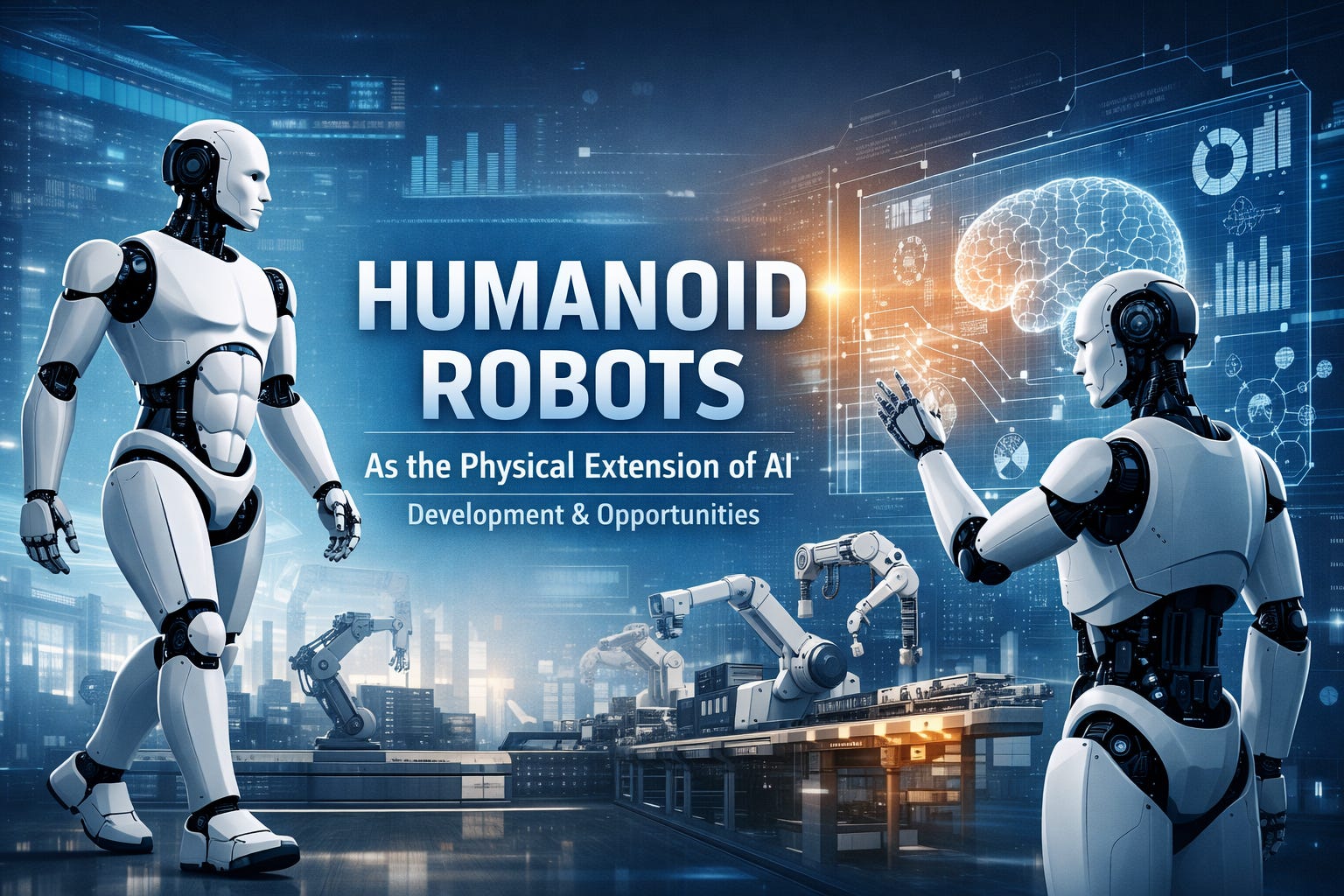
Humanoid Robots as the Physical Extension of AI | 人形机器人作为人工智能的物理延伸
Development Path, Policy Framework, and Structural Opportunities | 发展路径、政策框架和结构性机遇

Independent research on structural shifts in energy, technology, and capital.
聚焦能源、技术与资本结构性变化的独立研究。
For informational purposes only. Not investment advice.
仅供信息参考,不应被视为投资建议。
Introduction
Humanoid robots are increasingly framed as “physical AI” — a pathway through which artificial intelligence moves beyond perception and decision-making into real-world execution. At CES 2026 in Las Vegas, NVIDIA’s Chief Executive Officer, Jensen Huang, highlighted “physical AI” and presented robotics-related initiatives as part of the company’s next phase of artificial-intelligence development.
人形机器人正越来越多地被界定为“物理 AI”——即人工智能从感知与决策走向现实世界执行的一条关键路径。在 2026 年拉斯维加斯消费电子展(CES)上,英伟达首席执行官黄仁勋强调“物理 AI”,并将机器人相关计划纳入公司下一阶段人工智能发展的核心叙事。
In parallel, China has shifted from broad encouragement of robotics innovation towards a more structured, system-level approach that combines policy roadmaps, standardisation, and institution-building. The resulting question for industry research is no longer whether humanoid robots are impressive demonstrations, but whether they can evolve into reliable, manufacturable systems with verifiable economic value.
与此同时,中国正从相对宏观的鼓励创新,转向更系统化的推进路径——政策路线图、标准化与平台建设并行。由此,产业研究的核心问题已不再是人形机器人是否“足够惊艳”,而是它们能否成为可靠、可制造、且经济性可验证的系统。
I. Policy Roadmap and Institution-Building in China
China’s Ministry of Industry and Information Technology (MIIT) issued the Guiding Opinions on the Innovative Development of Humanoid Robots in late 2023. The document sets out explicit milestones: by 2025, an initial innovation system should be established, with breakthroughs in key areas such as the “brain, cerebellum, and limbs”, ensuring the secure and effective supply of core components; by 2027, technological innovation capability should be significantly enhanced, forming a safe and reliable industrial and supply-chain system and an internationally competitive ecosystem.
中国工业和信息化部于 2023 年末发布《人形机器人创新发展指导意见》,明确提出阶段性目标:到 2025 年,初步建立创新体系,在“大脑、小脑、肢体”等关键技术领域取得突破,确保核心部组件安全有效供给;到 2027 年,技术创新能力显著提升,形成安全可靠的产业链供应链体系,构建具有国际竞争力的产业生态。
Standardisation constitutes a second institutional lever. Under the framework of the National Robot Standardisation Technical Committee, dedicated humanoid-robot working groups have been convened, with participation from leading enterprises and research institutions. This reflects a deliberate sequencing of “standards first, scale later”.
标准化是第二个重要的制度抓手。在全国机器人标准化技术委员会体系下,人形机器人标准通过设立专项工作组推进,成员涵盖企业与科研机构,体现出“先标准、后规模”的推进逻辑。
Platform-based coordination represents a third lever. Public corporate registry records indicate that Beijing Humanoid Robot Innovation Centre Co., Ltd. was established on 2 November 2023 in Beijing Economic-Technological Development Area (Yizhuang), signalling an effort to concentrate testing, coordination, and ecosystem resources within a designated cluster.
平台化协同是第三个抓手。公开工商信息显示,北京人形机器人创新中心有限公司于 2023 年 11 月 2 日成立,落地北京经济技术开发区(亦庄),反映出通过集中测试、协同与生态资源来推动产业发展的组织思路。
Taken together, these measures suggest that China is approaching humanoid robotics not as a short-term industrial stimulus, but as a long-cycle strategic capability.
综合来看,这些举措表明,中国对待人形机器人并非短期产业刺激,而是将其视为一个需要长期投入与系统建设的战略能力。
II. A Historical Lesson: Demonstrations Are Not Commercialisation
Humanoid robotics has repeatedly delivered high-profile demonstrations without achieving sustained commercial outcomes. Honda’s ASIMO stands as a widely cited example. Developed over several decades, ASIMO showcased advanced locomotion, interaction, and coordination capabilities, yet long-term cost control and commercial viability remained unresolved, leading to the programme’s eventual retirement.
人形机器人历史上多次出现“展示能力突出、商业化长期受限”的情况。本田 ASIMO 是其中最具代表性的案例。该项目历经数十年研发,展示了先进的行走、交互与协调能力,但长期成本控制与商业可行性问题始终未能解决,最终被逐步退出。
The structural lesson is clear: technical sophistication alone does not guarantee economic sustainability. Without credible paths to cost reduction, reliability, and repeatable deployment, even advanced humanoid systems risk remaining demonstrations rather than scalable products.
其结构性启示在于:技术先进性本身并不能保证经济可持续性。若缺乏明确的降本路径、可靠性提升机制与可复制的部署模式,即便技术领先的人形机器人也可能长期停留在“展示品”阶段。
III. Technology Paths: Generality Versus Reliability
Most humanoid-robot development strategies can be broadly grouped into two technical philosophies.
End-to-end learning seeks to map perception and instruction directly into motion, aiming for generalisation across previously unseen tasks and environments. While this approach offers a high theoretical ceiling, it introduces challenges in explainability, debugging, and physical safety, particularly when behaviour is generated by large neural networks.
从技术路径看,目前人形机器人主要可归纳为两类技术哲学。
端到端学习试图将感知与指令直接映射为动作,追求跨任务、跨环境的泛化能力。这一路线理论上上限极高,但也带来可解释性不足、调试困难以及物理空间下安全风险提升等问题。
Modular architectures, by contrast, separate perception, planning, and control into constrained subsystems. This typically improves predictability, safety, and engineering control, and can facilitate manufacturing and certification, albeit at the cost of reduced flexibility and generalisation.
相比之下,模块化架构将感知、规划与控制拆分为受约束的子系统,通常能够提升可预测性、安全性与工程可控性,也更有利于制造与认证,但在灵活性与泛化能力上存在取舍。
In practice, commercially oriented systems increasingly converge on hybrid solutions, combining learning-based perception and skill acquisition with engineered safety envelopes and constrained controllers.
在产业实践中,面向商业化的系统正逐步走向混合路线:以学习型方法提升感知与技能获取能力,同时通过工程化安全边界与受约束控制器保障系统稳定性。
IV. Manufacturing and Deployment Constraints
For humanoid robots, the principal bottleneck lies not only in algorithms, but in manufacturability under enterprise-level reliability standards.
Human-shared environments sharply raise tolerance thresholds. Safety certification, failure rates, maintenance cycles, and serviceability frequently dominate adoption decisions. At the same time, energy density and thermal management remain binding constraints, as bipedal locomotion and manipulation are power-intensive even under steady-state operation.
对人形机器人而言,核心瓶颈不仅在算法层面,更在于是否能够在企业级可靠性标准下实现可制造性。
与人类共域作业显著抬高了容错门槛:安全认证、故障率、维护周期与可维护性往往成为采用决策的关键因素。同时,动力密度与散热仍是硬约束,因为双足行走与操作即便在稳态下也具有较高功耗。
As a result, early deployments, where they occur, typically focus on narrow, well-defined tasks — such as material handling, transport, or repetitive operations — where environments can be structured and performance metrics clearly defined.
因此,当人形机器人率先落地时,往往集中于任务明确、环境可控的场景,如搬运、转运或重复性作业,因为这些场景更易结构化、指标更清晰。
V. Global Competitive Landscape: Three Frontiers
The current global competition in humanoid robotics can be interpreted through three distinct frontiers.
The capability frontier concerns what robots can physically do — including dynamic balance, manipulation, and robustness. Public reporting from CES 2026 highlighted Boston Dynamics’ Atlas and its intended industrial applications within Hyundai’s manufacturing ecosystem.
当前全球人形机器人竞争可从三条“前沿”加以理解。
能力前沿关注机器人“能做什么”,包括动态平衡、操作能力与整体鲁棒性。CES 2026 的公开报道提及波士顿动力 Atlas,并指出其面向现代汽车制造体系中的工业应用。
The platform frontier focuses on models, simulation, and training pipelines — the software layer that lowers the cost of teaching robots new skills and transferring policies across embodiments. NVIDIA has explicitly positioned robotics and physical-AI tooling as a strategic direction.
平台前沿聚焦模型、仿真与训练管线,即降低机器人学习新技能成本的软件层,使策略在不同本体之间迁移成为可能。英伟达已明确将机器人与物理 AI 工具链视为战略方向。
The manufacturing frontier addresses cost reduction and reliability at scale: supply-chain control, serviceability, and lifecycle economics. Historically, this has been where many humanoid programmes have stalled.
制造前沿则关注规模化条件下的降本与可靠性,包括供应链可控性、可维护性与全生命周期经济性。历史经验表明,许多人形机器人项目往往在这一环节受阻。
VI. Opportunity Map: Where Structural Value Concentrates
From an industry-research perspective, opportunity is best defined by where technical barriers, cost weight, and bargaining power converge, rather than by short-term market catalysts.
从产业研究角度看,“机遇”更应被理解为技术壁垒、成本权重与议价能力集中之处,而非短期市场催化因素。
Upstream components — actuators, precision reducers, motors, ball screws, sensors, and control electronics — often carry both the technical moat and the majority of system cost. MIIT’s roadmap explicitly emphasises the secure and effective supply of core components, underscoring their strategic importance.
上游核心部件,如执行器、精密减速器、伺服电机、滚珠丝杠、传感器与控制电子,往往同时承载技术护城河与主要成本。工信部路线图明确强调“确保核心部组件安全有效供给”,进一步凸显了这一层的重要性。
Midstream integration — encompassing system engineering, reliability validation, and manufacturing processes — determines whether prototypes can become deployable products. Over time, this layer tends to consolidate around firms with scale and execution capability.
中游集成环节涵盖系统工程、可靠性验证与制造工艺,决定原型能否转化为可部署产品。随着时间推移,这一层往往向具备规模化与执行能力的企业集中。
Downstream deployment is currently most viable in controlled enterprise environments — manufacturing, logistics, and high-risk operations — where returns can be quantified and safety engineered. Household service remains a longer-dated scenario due to higher reliability, liability, and cost thresholds.
下游部署在受控的企业环境中更具可行性,如制造、物流及高风险作业场景,因为回报可量化、风险可工程化。家庭服务由于可靠性、责任界定与成本门槛更高,仍属于较远期应用。
VII. Risks and Non-Linear Progress
Progress in humanoid robotics is rarely linear. Demonstrated capability may advance rapidly, while deployment lags.
人形机器人的发展往往并非线性:展示能力可能快速提升,但实际部署进展缓慢。
Key structural risks include production timelines advancing ahead of reliability maturity, safety and liability constraints in human-shared environments, dependence on high-precision component supply chains, and mismatches between policy expectations and product readiness. A disciplined research approach therefore tracks manufacturability indicators — component lifetimes, maintenance cycles, failure rates, certification progress, and repeatable customer deployments — rather than promotional milestones.
关键结构性风险包括:量产节奏超前于可靠性成熟度、与人共域作业带来的安全与责任约束、高精度核心部件供应链依赖,以及政策预期与产品成熟度之间的错配。因此,更严谨的研究应关注可制造性指标,而非宣传口径。
Conclusion
Humanoid robots are best understood as an emerging layer of physical-AI infrastructure. Their long-term potential is significant, but near-term progress will be shaped primarily by manufacturability, reliability, and institutional frameworks rather than demonstrations or aggressive volume targets.
人形机器人更适合被理解为“物理 AI 基础设施”的新层级。其长期潜力值得关注,但短期进展将更多由可制造性、可靠性与制度框架决定,而非演示或激进量产目标。
China’s emphasis on policy roadmaps and standardisation signals an intention to compete across the full technology stack. Globally, the decisive question is shifting towards who can deploy humanoid robots reliably at scale. Structurally grounded opportunities, therefore, tend to concentrate in core components, integration capability, and enterprise-grade deployment scenarios where economics can be verified.
中国通过政策路线图与标准化并行的方式,体现出参与全栈竞争的意图。在全球层面,决定性问题正转向“谁能在规模化条件下实现可靠部署”。因此,更具结构支撑的机会通常集中于核心零部件、系统集成能力以及经济性可验证的企业级应用场景。
Data & Sources
Ministry of Industry and Information Technology (MIIT), Notice on Issuing the Guiding Opinions on the Innovative Development of Humanoid Robots (MIIT Ke [2023] No. 193; published 2023-11-02).
National Robot Standardisation Technical Committee — coverage of humanoid-robot standard working group meeting (March 2024, hosted at iFLYTEK in Hefei).
Beijing Humanoid Robot Innovation Centre Co., Ltd. — public registry record (established 2023-11-02; Beijing Economic-Technological Development Area).
NVIDIA Blog — CES 2026 special presentation (Jensen Huang keynote context).
Associated Press — CES 2026 Day 1 coverage referencing “physical AI” and robotics highlights.