

Electricity Constraints and the Role of Nuclear Power in the AI Era |人工智能时代下的电力约束与核能角色

Independent research on structural shifts in energy, technology, and capital.
聚焦能源、技术与资本结构性变化的独立研究。
For informational purposes only. Not investment advice.
仅供信息参考,不应被视为投资建议。
Artificial Intelligence and the Structural Shift Toward Electricity
Artificial intelligence represents a milestone in the history of human technological progress. As AI capabilities and deployment scale rapidly, the global economy is gradually transitioning from an era primarily driven by fossil fuels toward one increasingly powered by electricity.
人工智能无疑是人类科技发展史上的一次里程碑式突破。随着人工智能能力和应用规模的迅速扩展,全球经济正逐步从以化石能源为核心驱动力的阶段,迈向一个以电力为关键基础的新时代。
This shift is structural rather than cyclical. AI does not merely add incremental electricity demand; it reshapes the load profile of power systems by introducing large, continuous, and highly concentrated sources of consumption.
这一转变并非周期性变化,而是结构性的。人工智能不仅带来边际用电增长,更通过引入规模大、连续运行且高度集中的负载,重塑了电力系统的需求结构。
Data Centers as a Core Driver of Power Demand
The training and deployment of AI models take place primarily in large-scale, power-intensive data centers. According to the International Energy Agency’s analysis of data center electricity demand, complemented by industry database estimates, there are currently several thousand data centers worldwide, with roughly one-third located in the United States and significant concentrations in Europe and China.
人工智能模型的训练与部署主要发生在大型、高耗电的数据中心中。根据国际能源署(IEA)对数据中心用电需求的分析,并结合行业数据库的综合估计,目前全球存在数千个数据中心,其中约三分之一位于美国,欧洲和中国也占据重要比例。
A typical AI-focused data center consumes electricity comparable to that used by tens of thousands of households. Some hyperscale facilities currently under construction are expected to require several times that amount, placing unprecedented strain on local and national power systems.
一个典型的人工智能数据中心,其用电规模可与数万户家庭相当;而部分正在建设中的超大规模数据中心,其电力需求预计将达到这一水平的数倍,对地方乃至国家级电力系统形成前所未有的压力。
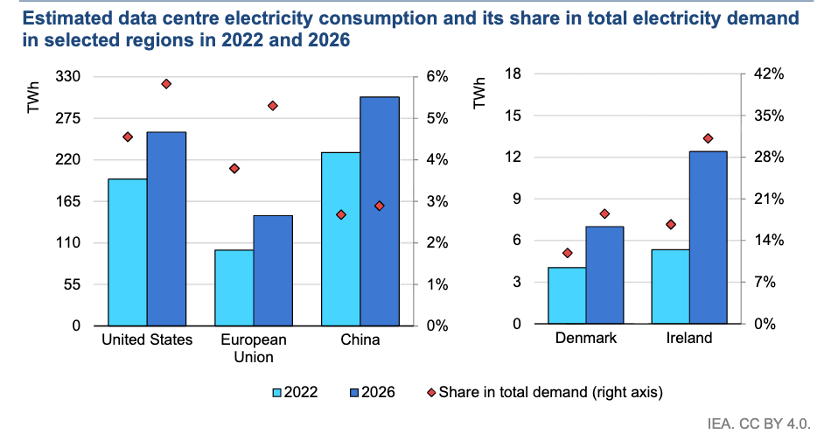
Under current estimates, global data centers consume approximately 508 terawatt-hours (TWh) of electricity annually. Over the coming decade, this figure is expected to rise substantially, increasing the share of data centers in total global electricity demand.
按照现有估算,全球数据中心目前每年消耗约508太瓦时(TWh)的电力。未来十年内,这一数值预计将显著增长,数据中心在全球总用电量中的占比也将随之上升。
The following chart shows the estimated electricity consumption of data centers in select regions in 2022 and 2026 and their share of total electricity demand:
下图为2022年和2026年部分地区数据中心估计用电量及其在总用电需求的份额:
Data source: International Energy Agency (IEA).
数据来源于:国际能源署(IEA)
The Central Constraint: Where Does the Electricity Come From?
This rapid increase in electricity demand raises a fundamental constraint: how can power systems deliver reliable, affordable, and continuous electricity at the scale required?
电力需求的快速上升引出了一个根本性问题:电力系统如何在足够规模下,持续、可靠且具备成本可控性地提供所需电力?
In many economies, thermal power—particularly coal-fired generation—continues to play an important role. However, under tightening climate policies and emissions constraints, thermal power faces long-term structural pressure to decline rather than expand.
在许多经济体中,火力发电(尤其是煤电)仍在电力结构中占据重要位置。然而,在日益严格的气候政策和减排约束下,火电面临的是长期的结构性压缩压力,而非扩张空间。
Renewable energy sources such as wind, solar, hydro, biomass, and geothermal power are expanding rapidly. Yet their intermittency, weather sensitivity, and reliance on large-scale energy storage continue to pose challenges for power systems that must support high-load, continuous operation.
风能、太阳能、水能、生物质能和地热能等可再生能源正在快速发展,但其间歇性、对天气条件的高度依赖以及对大规模储能的需求,使其在支撑持续高负荷运行方面仍面临现实约束。
Natural Gas and Nuclear Power as System-Level Options
As high-emission sources are increasingly constrained and intermittent renewables face system-level limitations, the range of viable options for large-scale, stable power generation narrows significantly. In practice, this leaves natural gas and nuclear power as the two primary system-level choices.
随着高排放能源逐步受到约束、而可再生能源在系统层面存在局限,可用于大规模、稳定发电的选项明显收窄。在现实中,天然气发电和核电成为主要的系统级选择。
In 2022, the European Union classified natural gas and nuclear energy—under specific conditions—within its Sustainable Finance Taxonomy. This reflects a pragmatic recognition of their transitional role in maintaining energy security and system stability, rather than an endorsement of unrestricted expansion.
2022年,欧盟在特定条件下将天然气与核能纳入《可持续金融分类法》(EU Taxonomy),这体现的是一种务实立场,即承认其在能源转型过渡期内对保障能源安全和系统稳定的阶段性作用,而非对其无限制扩张的认可。
However, natural gas supply has become increasingly constrained, particularly in Europe. The closure of the Groningen gas field in the Netherlands significantly reduced domestic supply capacity, while increased reliance on liquefied natural gas introduces higher costs and greater price volatility compared with pipeline gas.
然而,天然气供应正面临日益明显的约束,尤其是在欧洲。荷兰格罗宁根气田的关闭显著削弱了本土供应能力,而对液化天然气的依赖则带来了更高的运输成本和更大的价格波动。
The Re-Evaluated Role of Nuclear Power
Against this backdrop, the system-level attributes of nuclear power become increasingly relevant. Nuclear energy offers large unit capacity, high capacity factors, stable baseload generation, a relatively small physical footprint, and near-zero operational carbon emissions.
在这一背景下,核电的系统性特征愈发受到重视。核电具备单机容量大、利用小时数高、发电稳定可靠、占地规模小以及运行过程中几乎不产生碳排放等优势。
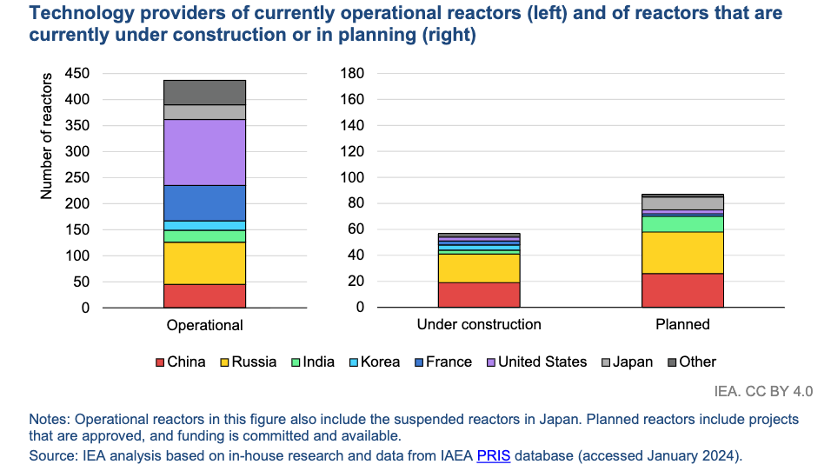
The chart below shows the reactor technology supplier in operation (left) and the reactor under construction or planning (right) as of January 2024:
下图为截至2024年1月,运行中的反应堆技术供应商(左)和正在建设或规划中的反应堆(右):
Data source: International Energy Agency (IEA).
数据来源于:国际能源署(IEA)
According to the International Atomic Energy Agency, as of 19 November 2025, there are 416 nuclear reactors in operation worldwide, providing approximately 376 gigawatts of electric capacity. In 2024, nuclear power generation totaled about 2,617 TWh, supplying a significant share of low-carbon electricity across multiple regions.
根据国际原子能机构(IAEA)的数据,截至2025年11月19日,全球共有416座在运核反应堆,装机容量约为376吉瓦(电)。2024年,全球核电发电量约为2617太瓦时,在多个地区的低碳电力供应中发挥着重要作用。
In countries such as the United States, China, and several European nations, nuclear power remains a cornerstone of electricity system stability and decarbonization strategies. Dozens of reactors remain under construction globally, underscoring sustained investment in nuclear capacity as part of long-term power planning.
在美国、中国以及多个欧洲国家,核电仍是保障电力系统稳定运行和实现减排目标的重要支柱。全球范围内仍有数十座反应堆在建,反映出各国在长期电力规划中对核能的持续投入。
Conclusion: Nuclear Power as a Structural Component of an Electricity-Constrained World
Taken together, AI-driven electricity demand growth, constraints on traditional energy supply, and the system-level limitations of intermittent renewables point toward a re-evaluation of nuclear power’s role. Rather than a short-term policy response, nuclear energy is increasingly being assessed as a structural component of electricity systems in an era defined by power constraints.
综合人工智能驱动的电力需求增长、传统能源供给约束以及可再生能源的系统性局限,核能正被重新审视其在电力体系中的角色。这并非短期政策调整的结果,而是在电力约束日益凸显的时代背景下,核能作为结构性组成部分的再定位。
Future power infrastructure holds significant potential.